
Connect Drug Targets, Disease Genes and Virus Interacting Proteins
Quick Start Instructions
In this section you can create subnetworks that connect drug targets, viral proteins, and disease genes through known protein-protein interactions. The drug-target interactions are originated from DrugBank; the disease gene lists are derived from OMIM; and the virus-host interactions are derived from VirusMINT. These sources produce bipartite graphs where one side of the graph is represented by drugs, diseases, or viral proteins, and the other human genes. The human genes from each of these categories are connected through known protein-protein interactions collected from 18 publicly available databases.
To build subnetworks click below to add drugs, diseases, viruses, or any other genes of interest; then select the desired path length, and then press Run.
To add a drug/disease/virus/gene click the appropriate add tab on the bottom. Enter a corresponding drug/disease/virus/gene in the add input area. Added elements will appear above the input area. Click the small red "x" next to an element to remove it from the list. Click on the color to change the color of the element in the network.
Maximum path length controls the number of intermediate genes that will be added if they fall along paths between the entered input selected genes. A max path length of 1 will only connect the entered genes. Longer path lengths will pull in additional intermediate genes/proteins.
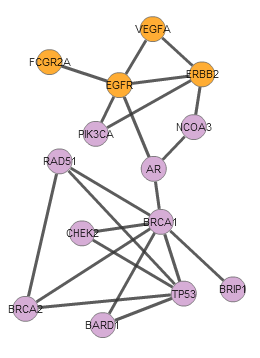
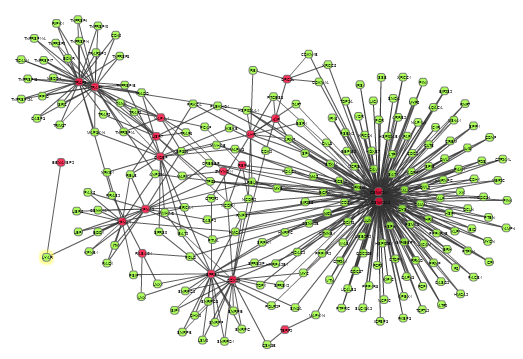
Once genes and gene categories were added, colors chosen, and path length selected, press Run to build a subnetwork. The color of genes shown in the legend correspond to the entered drug targets, disease genes, virus interacting proteins, and intermediate genes. The significance of any intermediate pulled in is listed in a table of ranked genes by z-score generated using a binomial proportion test. See the about page for additional information. The two examples shown above represent a subnetwork created for familial breast cancer disease genes from OMIM and drug targets for the drugs: Trastuzumab (Herceptin), Lapatinib (Tykerb), and Bevacizumab (Avastin) used as targeted therapy in breast cancer (left); and a protein-protein interaction subnetwork created from seed list of proteins interacting with Epstein-Barr viral proteins.
